
Vanuatu’s Daily Post recently wrote about the Vanuatu Skills Partnership I have been working on … the full article is reproduced below.
Born only days apart yet from two very different worlds—one shaped by Hollywood film sets and the other by village weaving circles—Rosie Boylan, an Australian hat maker and Janet Sine, a Santo community leader came together through the Vanuatu Skills Partnership to establish a thriving social enterprise. This is their story.
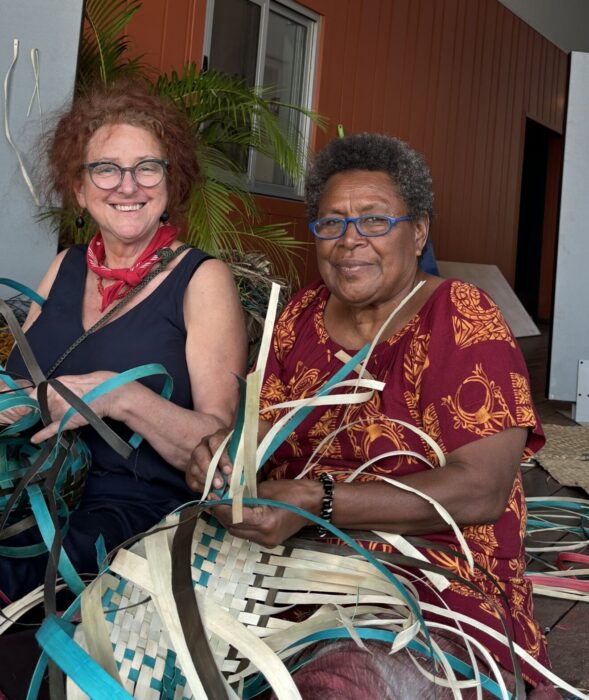
Rosie: I grew up on a sheep and cattle farm in rural South Australia, which is why I’ve always felt at ease in places like Santo. Hat making wasn’t something I dreamed of, but after studying creative arts and technical theatre I trained under a senior hat maker in Sydney. That set me on a 40-year career making hats for stage and screen, including The Great Gatsby andMoulin Rouge.After that, I longed for something more real, more connected to traditional crafts and the land. I always carried a quiet certainty that one day I would be drawn to the Pacific in my working life. That chance came in 2015 when I travelled to Santo and was struck by the weaving and the warmth of the community, and met Janet—who would become my sister, colleague, and friend.
Janet: When Rosie first came after Cyclone Pam, she met with us women. I remember those workshops clearly. We sat together in groups, sharing pandanus leaves and our traditional ways of weaving. Rosie didn’t weave, but she had an eye for detail. She saw straight away what made a hat strong, what made it stand out. At first, I wondered why a woman from Sydney, from big movies and city life, would care about our small island craft. But then I realised she wasn’t here to take over—she wanted to work alongside us. I didn’t know it then, but she saw something in me too. She noticed my interest in organisation and leadership. We were born only ten days apart, and since then our lives have run side by side, though from such different beginnings.
Rosie: The weaving tradition here was already strong, but the hats were not refined. Many looked beautiful but lacked the shape that international buyers would expect. I never wanted to change the culture or the tradition, only to collaborate. Together through our work with Vanuatu Skills Partnership, we transformed flat weaving into three-dimensional hats. We experimented with patterns, tested different weaves, and laughed when the first attempts collapsed. I would talk about the “buyer’s eye”—how tourists or overseas markets would see the product. It wasn’t always easy. Some women worried that changing shapes might mean losing culture. But we worked carefully, always returning to the roots of their skills. Soon, the women built a catalogue worthy of international markets. Through cyclones, COVID, airline collapses, and even earthquakes, they never gave up. These women were more than Mammas; they had grown to become confident entrepreneurs.
Janet: At first Rosie led most of the work, because we needed someone with experience in quality control and international standards. But over time she stepped back and I grew into my role. She taught me to trust my own leadership. We had disagreements but always respect. Sometimes I would say, “No Rosie, this is how we weave here,” and she would listen. Other times she pushed me to think bigger, to consider what it would mean for a woman in Santo to run a business that could sell beyond Vanuatu. That was new for me. She showed us that we could support each other, not compete. That changed everything. Our group became stronger, more united, and more confident.
Rosie: Beyond weaving, our friendship has been about life itself—cash flow, family responsibilities, community expectations. We spoke often about the challenges women face, whether in Sydney or Santo. I admired Janet’s faith. Once we were stuck on Malo with no fuel and no generator, wondering how to get off the island. Janet simply said, “We’ll just pray.” And truly, her prayers carried us through. That kind of faith has kept us steady. Coming from a career where deadlines and budget rule, it was a lesson in patience and quietly trusting.
Janet: My faith is part of everything I do and my strength is always built up from Philippians 4:13. It gave me courage to keep going, even when things were uncertain. And together we learned that women can be business leaders too, not only caretakers. The respect from our families and communities has grown because of this work. Husbands who once thought weaving was just a pastime now see it as income. Children see their mothers as role models and begin to change their mindset towards weaving.
That transformation has been just as important as selling hats.
Rosie: Earlier this year, we travelled with a group of weavers to northern Australia. At the Darwin Aboriginal Art Fair, the women saw a new scale of possibility—fashion shows, awards nights, glossy displays. The professionalism was impressive, but what mattered most was seeing Indigenous artists being respected for their culture. Then in Gapuwiyak (a small community in Arnhem Land, Northern Territory) we met Yolngu pandanus weavers. Their pandanus is different, their weaving is different, but the connection was powerful. First Nations women from communities only a few thousand kilometres apart, meeting and sharing for the first time. That experience was unforgettable. It reminded me that weaving is not just about craft; it is about identity, belonging, and recognition.
Janet: It opened our eyes. We saw how creative industries could grow in Vanuatu too. It was more than weaving—it was about friendship, diplomacy, and recognising our place in the world. But even before that trip, we already dreamed of having our own art centre. For years we worked at the back of the Sanma Skills Centre or even under a tree, always wishing for a proper space. The visit just made that dream feel urgent and possible. When we saw the Yolngu women open their new art centre after ten years of effort, we said to ourselves, “Now it’s our turn.”
Rosie: I think as Janet and I get older; we are on a sustainability plan. We’ve got another generation of people coming and together we have laid the foundation of this enterprise, and now we have a new manager who is much younger, and she brings great financial and business skills, and we’ll be bringing on other people who can complement that.
Janet: The SANMA Creative Hub, also known as the Sanma Creative Industries Community Company, was officially established in 2020 because of the years of work and collaboration we had already done with the women and with the support of the Vanuatu Skills Partnership. By the time of our Arnhem Land trip, the hub had long been active—securing copyrights, opening a retail outlet at Pekoa Airport, and participating in events like the Vanuatu Made Trade Show to expand market access for our members. The airport shop has become a landmark, where visitors buy authentic Vanuatu-made products. International orders are increasing, and the brand of Santo weaving is becoming recognised. As Rosie said, we are in our late 60s, and we know the next generation will carry it forward. What makes me proud is not only the hats we sell but the confidence I see in the women when they say, “We are businesswomen.”
Rosie: One of my favourite memories came in Gapuwiyak. For the first time Janet and I sat down and wove together. Just a simple Vanuatu bag—but it carried all the years of teaching, listening, laughing, and building trust. That bag was not just pandanus; it was a reminder that our two lives, from two very different worlds, had become one shared journey.
Janet: After all those years of planning, teaching, organising, and pushing for something bigger, to finally sit down and simply weave beside Rosie felt different. It was quiet, almost ordinary, yet for me it carried a deep relief. I realised how much I had missed the simplicity of just weaving without thinking about markets or meetings. Sitting there, I felt proud—we had built something strong, but in that moment, it was just two women, two friends, weaving together and enjoying the peace that came with it.
See : Vanuatu Daily Post Article
Rosie Boylan
No comments yet.